Last week I told you there’s no AEO schema. The foundation of search visibility, AI or otherwise, is still plain old technical SEO, and Google’s own documentation says so.
This week: the house you build on that foundation. Starting with a confession about my own.
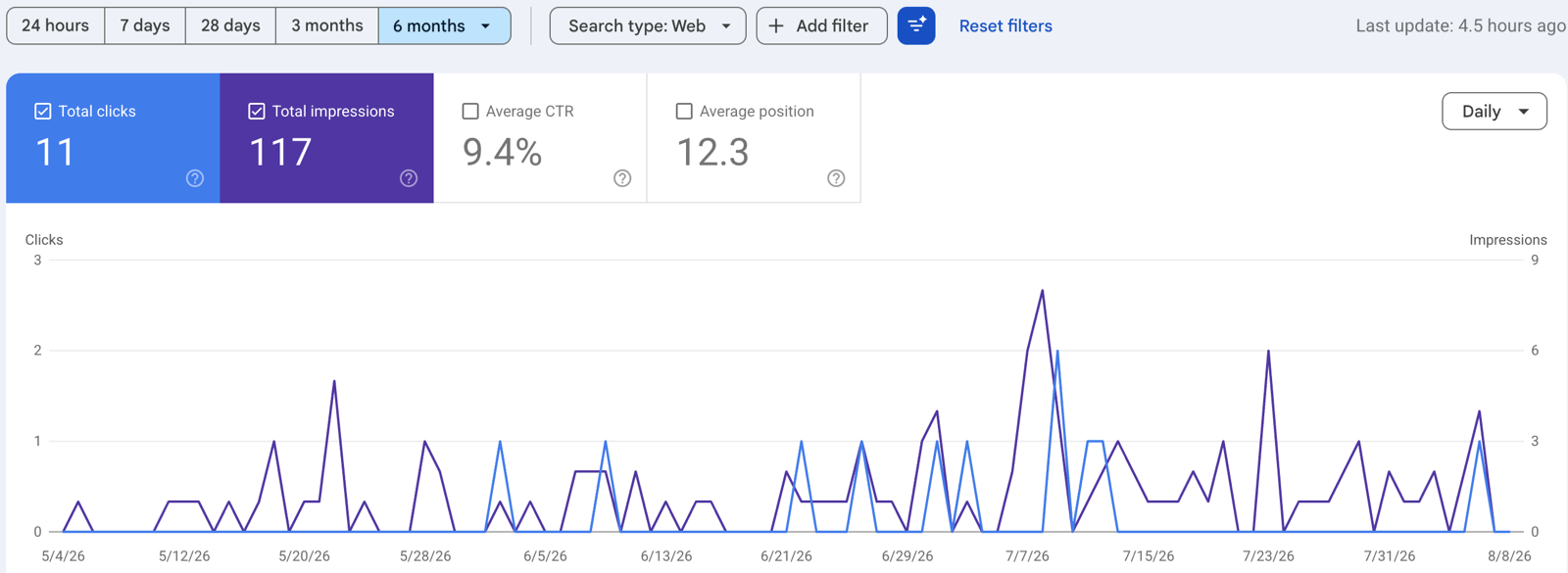
My website scores essentially perfect on a technical audit. Clean crawl, server-side rendering, correct schema, fast, secure. And in six months live, my top search queries, straight from Google Search Console: “workloom.” “Hloom resume.” “Flyloom.” “Loom automation.”
Not one visible query was a person looking for what I do. My entire organic footprint is people mistyping other companies’ names. A perfect building, and the only foot traffic is folks looking for a different address.
That’s not a failure of the foundation. It’s the whole point of this post: you can’t rank for words that aren’t there.
The flood is real
Graphite, an SEO research firm, analyzed 65,000 web articles from Common Crawl and found AI-generated articles briefly outnumbered human-written ones in November 2024 (up from about 5% before ChatGPT existed), and the two have run roughly even since. Ahrefs separately found nearly three-quarters of 900,000 newly published pages contained at least some AI content. Machines now write about half the internet, and the volume side of that trade has never been cheaper.
Here’s the other side.
Almost nobody sees it
The same Graphite research checked what actually surfaces: 86% of articles ranking in Google Search are human-written. 82% of what ChatGPT and Perplexity cite: human-written. Semrush graded 42,000 blog posts and found the #1 position on Google is about 8x more likely to be human-written than AI-generated. (Honest caveat: AI detectors are imperfect and most real content is a blend, so treat exact percentages as directional. The direction shows up in every study that’s looked.)
Half of everything published, roughly a seventh of what anyone sees. The flood exists. It’s just invisible. Most AI-generated pages are never ranked, never cited, never read by anyone but the crawler that indexed them.
Why does the flood sink? Because most of it is the same article, rewritten. The ten-thousandth “5 Ways AI Can Help Your Small Business” adds nothing to the 9,999 before it. Google holds a patent on measuring exactly this, an “information gain” score: how much a page adds beyond what the index already contains. Never confirmed as a ranking factor, but Google’s published AI-search guidance now uses nearly the same language, telling creators to focus on unique, non-commodity content: original research, first-hand experience, information that doesn’t exist elsewhere.
That’s the bar now. Not “is this page well-written.” Not even “is this page helpful.” The bar is: does this page contain something a thousand AI summaries can’t generate?
Full disclosure: a machine helped write this
Cards on the table: I drafted this post with Claude. I use AI in my writing the way I use it everywhere else in my business: as leverage, with my hands on the wheel.
Because the honest lesson of the data above is not “humans good, AI bad.” The real line is commodity versus non-commodity. An AI-drafted post built on your real experience, real data, and a position you’ll defend can clear the bar. A hand-typed post restating the top ten search results cannot. The tool was never the problem. The input is.
Everything in this post worth reading (the story I’m about to tell you, my embarrassing Search Console numbers, the experiment at the end) came from doing the work. The machine just helped me type it.
Why my site is invisible on purpose
Before WorkflowLoom, I spent fifteen years on the client side of the table, evaluating vendors who wanted to sell me technology. Eleven of those years I ran marketing for a trucking company, where we grew organic traffic more than tenfold over a decade and doubled the fleet while cutting cost-per-hire. So I’ve built this machine before. Just never for myself. And the first thing I did every single time a vendor pitched me: I checked their website. Not the case studies. The site itself. Fast, clean, correctly built? Because a vendor selling technical excellence from a broken website has already told you everything you need to know.
So I built my own site to pass that exam. What I never built it for was marketing. Nearly all of my business comes from referrals, and a referred prospect doesn’t find you through search. They already have your name. They visit your site to validate you.
That’s what a technically perfect site actually is for a referral business: a trust artifact, not a traffic engine. And it’s been quietly doing that job fine.
And this isn’t even my first time not marketing. My previous business ran for 25 years, and its website, priboy.com, says “Coming Soon… Since 1999.” Not a joke page. The actual site, live right now, exactly as it’s been for a quarter century:

I never built it because I never needed it. The referral backlog never let up long enough. The best marketing I ever did was work somebody wanted to refer.
So why start now? Two reasons, 1. Because the referral pipeline grew a new last mile. It used to end with one human giving your name to another. Today the referred prospect asks ChatGPT about you before they call, and the strangers you’ll never get referred to ask the same machines who to hire. Word of mouth now includes mouths that aren’t human. 2. To prove my point that Tech SEO/AEO/GEO are indeed the foundation but you need a house (content) because you can’t rank for content that doesn’t exist.
But it means my perfect audit score and my invisible search presence aren’t a contradiction. They’re two different instruments measuring two different things. The audit measures whether you can rank. Content determines what you rank for. I have a 100 on the first and nearly nothing on the second, because I never put the words there.
Which raises an obvious question: what happens if I do?
The machines that describe me but can’t name me
Before starting, I set a baseline, and this part genuinely surprised me.
I asked ChatGPT and Perplexity, in clean sessions, who a small business should hire for search and AI visibility. Neither named a single company. Both described the ideal hire instead, and the description was eerie: audit first, traditional SEO as the foundation with AI visibility as an add-on, and beware anyone selling special “AEO schema” or hundreds of generic AI-written articles. The answer engines are warning buyers away from the slop machines, while reciting, almost word for word, the argument I published last week.
Both machines preach my positioning. Neither can retrieve my name. Words that aren’t there.
Then I asked both engines who does workflow automation and AI consulting for small businesses in Oklahoma. They named real vendors, a dozen-plus across the two platforms. WorkflowLoom appeared exactly zero times, which is what a site with no content deserves. But two details matter more than my absence.
First, the engines’ lists barely overlapped, and even the same engine asked twice produced substantially different names. In a thin market, the AI answer set isn’t settled. It’s volatile, which means it’s winnable.
Second, ChatGPT’s answer arrived with a map and star ratings attached. It was visibly reading business listings and review data, not blog posts. The entry ticket isn’t better articles alone; it’s being present and consistent in the places the engines already trust. Content builds the authority; the entity plumbing gets you in the room. More on that in a future installment.
The experiment
So here’s what I’m doing, in public, starting now.
I’ve mapped the universe of terms that actually matter for my business. Not “workflow automation,” which belongs to software companies with nine-figure ad budgets, but the intersections where a solo consultancy can genuinely be the best answer: AI operations for non-technical owners, honest audits that cover AEO and GEO without the hype, the questions owners type when their site looks fine but nobody comes.
Every month I’ll publish content built against that map, each piece carrying something non-commodity: first-hand data, real audits, positions I’ll defend. And every month I’ll report what moved: impressions, queries, clicks, and whether the answer engines have learned my name yet.
The first brick is already laid: an implementer’s guide to the best AI workflow automation platforms, the independent comparison that a search results page full of vendor self-reviews doesn’t have.
Baseline, on the record, August 2026: 117 impressions in six months. 11 clicks. Average position 12.3. Top queries: other companies’ typos. AI citations: zero.
A technically perfect site is the best foundation you can pour. But the foundation was never the house. The house is content, and starting now, I’m building my “house” in public and you can watch the metrics as I go.
Previously: There Is No AEO Schema
Want to know where your site stands, foundation and house both, with numbers attached instead of opinions? That’s a 30-minute conversation: request a call. This post is also on LinkedIn, arguments welcome there.
